Did Apple Maps remove the names of Lebanese towns and villages?
Last week I started to see social media posts and news articles on missing names of villages and towns in Southern Lebanon in Apple Maps. Given the current Israeli invasion and occupation of Southern Lebanon, this news was disturbing to see. The more I looked into it, the more I came to realise that this issues has actually been a long standing one, with inconsistent messaging and facts around why.
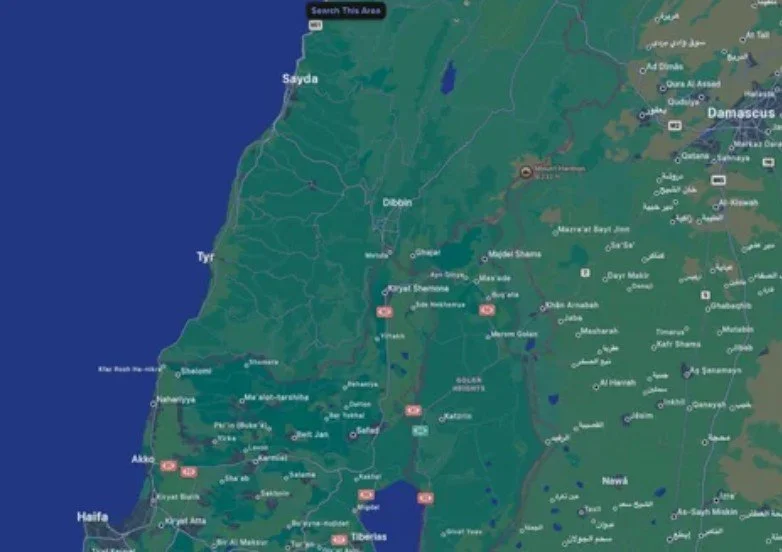
Apple have denied the missing names are deliberate and claim these locations were never featured on their maps because “the newer mapping experience is not available in that region”. When I did some more digging, I found the gap in Apple Maps pre-dates the current invasion and occupation, with this news outlet claiming “there is no evidence of recent deletions. No before-and-after comparisons have surfaced proving that these specific labels were visible on Apple Maps previously and then removed. Archived user complaints about limited mapping detail in Lebanon date back several years, indicating this is a longstanding data coverage gap rather than a sudden, targeted change.”
I personally could not find any before-and-after comparison photos, so my research has come to the same conclusion as this claim; however, I also could not find evidence of the archived user complaints. This does not mean they do not exist and in fact, I am inclined to believe they do exist because they point to a broader problem - inconsistent representation.
Apple have claimed a lack of availability “in that region” is the reason for the missing names, yet Northern Israel, which borders Southern Lebanon, does not show any missing names of towns or villages in Apple Maps. The distance between Beirut and Tel Aviv is about 210 kilometers (130 miles). This article in The Beiruter describes this distance as roughly equivalent to traveling from New York City to Boston or from London to Birmingham. Lebanon is geographically very small, so when Apple make the claim of a lack of availability in that region, the argument doesn’t hold up to the reality of the geographical size of that region and its proximity to its neighbour, which does not seem to be subject to the same limitations.
This consequently surfaces broader questions around why one country in that region is provided availability and accessibility when another is not.
There’s a great article written by Sophia Goodfriend on censorship in Google maps in Hebron, Palestine which is located in the West bank. She writes about her experience attempting to use Google maps in that city and finding the area appears largely blank on the platform, despite being the largest city in the West Bank. The article goes on to talk about a Palestinian photographer, Wesam, who creatively leverages user-generated Google Street View to fill in the gaps Google left behind.
The issue of inconsistent representation in that region is a longstanding one, extending to both Lebanon and Palestine, and points to much broader issues that are tied into the history of these countries. While it may be factually correct that Apple did not erase the names of towns and villages in Southern Lebanon, this fact holds true alongside the additional fact that Israel does not seem to be affected by this alleged lack of availability, despite also being in the heart of that region. It’s hard to separate the latter fact from the longstanding battles Palestinian and Lebanese people have fought to retain and protect their rights to their sovereign land. The digital erasure of towns and villages, be it longstanding or otherwise, adds salt to a gaping wound.
Apple have made the effort to deny the accusations of deliberately erasing the names of towns and villages in Southern Lebanon, but they have made no effort to communicate if this problem will be addressed and rectified. They have given an alleged, and unsubstantiated, reason for the missing names - a lack of availability - but have not provided any indication that efforts will be directed towards addressing this alleged limitation. They point to archived user complaints as evidence of the issue being longstanding and not a product of the current conflict; however, there is no evidence of attempts, both past and present, to address these complaints.
The issue has been minimised to an alleged technical limitation, reducing a long history of a fight against erasure to an issue of availability. This technical justification for the missing names does not hold true against the reality of representation in that region. We cannot prove if the longstanding issue of missing names is deliberate, nor can we prove if the gaps in Google Maps of the West Bank are deliberate; however, we can point to the factual evidence of an imbalance of representation in that region and ask the question: why one and not the other?